
Only the faintest glimmers of sunlight can penetrate through to the ocean’s Twilight Zone—a hazy liminal space that marine travelers must pass through on their descent into total darkness. It’s the perfect place for sharks to lurk. But the specifics about where they go and what they do in the shadows of this limbo-like underworld still remain largely unknown to biologists.
What they do know is that in the depths of the Twilight Zone, which range from 650 to 3,300 feet (or 200 to 1,000 meters) below the surface, there are secret corridors through which sharks travel across the oceans unnoticed. Although standard satellite-paired tags on sharks have been able to illuminate some of this behavior, there are still gaps in data, due to limits in current technology. A new tag is on the way, and scientists hope that it can combine the best features of existing marine technologies to give a clearer picture on how sharks are navigating through the Twilight Zone.
Simon Thorrold, a senior scientist at Woods Hole Oceanographic Institution, holds a grayish bulbous device that fits in the palm of his hand. It’s called a pop-up satellite archival transmitting tag, he explains, and it’s one of the conventional tags that scientists use to track ocean animals, like sharks and tuna, on the move. It attaches onto the muscle tissues of the animal through a short tether, and it constantly logs temperature, depth, and light levels. The device uses its detection of light levels, like the time of sunrise, sunset, and the length of day, to provide an approximate position, like whether the fish is in the Mediterranean, or the Gulf of Mexico.
After a set time period, maybe a couple months or so, a burn wire activates, detaching the tag and allowing it to pop up to the surface. The tag does not communicate with any satellites through that entire deployment. When it pops up at the end, it transmits a summary of the data on the tag to an orbiting satellite, and back to researchers in their office.
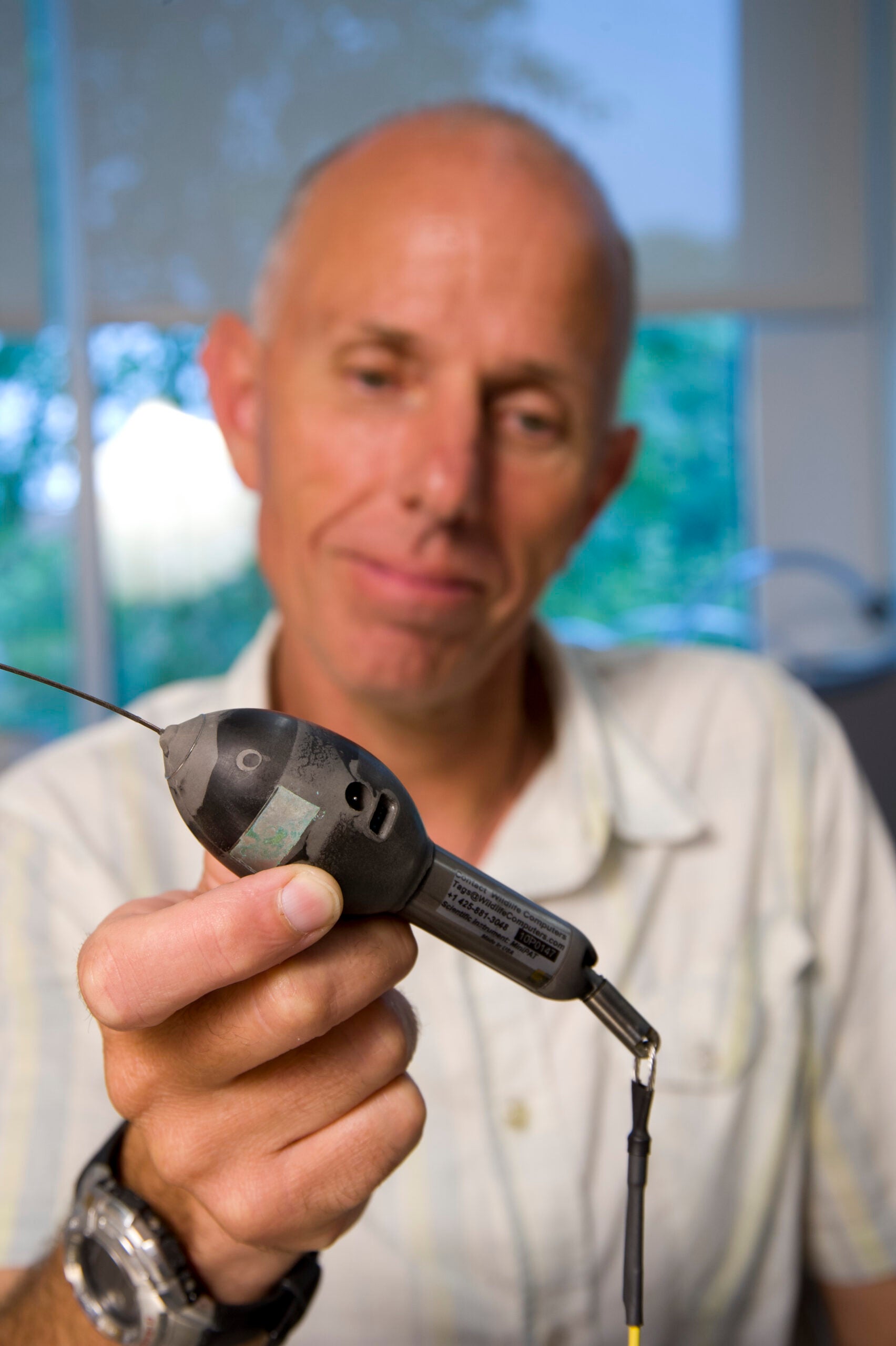
Another palm-sized tag, called SPOT, has been used to get more accurate locations on animals, but it can be a mile or so off.
These tags are common and reliable, but they have their shortcomings. The pop-up tags need light for geopositioning. “If we’ve got species that are spending a lot of time in the Twilight Zone where there is very little light, we effectively lose those fish or those sharks anytime they’re down deep. That’s a real problem because a lot of large pelagic fish spend a significant amount of time deep where this light level doesn’t even work,” Thorrold says. “There’s kind of a hole in terms of our tagging technology.”
The SPOT tags, meanwhile, can only transmit data when circumstances align—the tag-wearing animal has to travel to the surface for the tag to communicate with an orbiting satellite and get a position. And SPOT tags are only really suitable for large individual marine creatures with rigid dorsal fins.
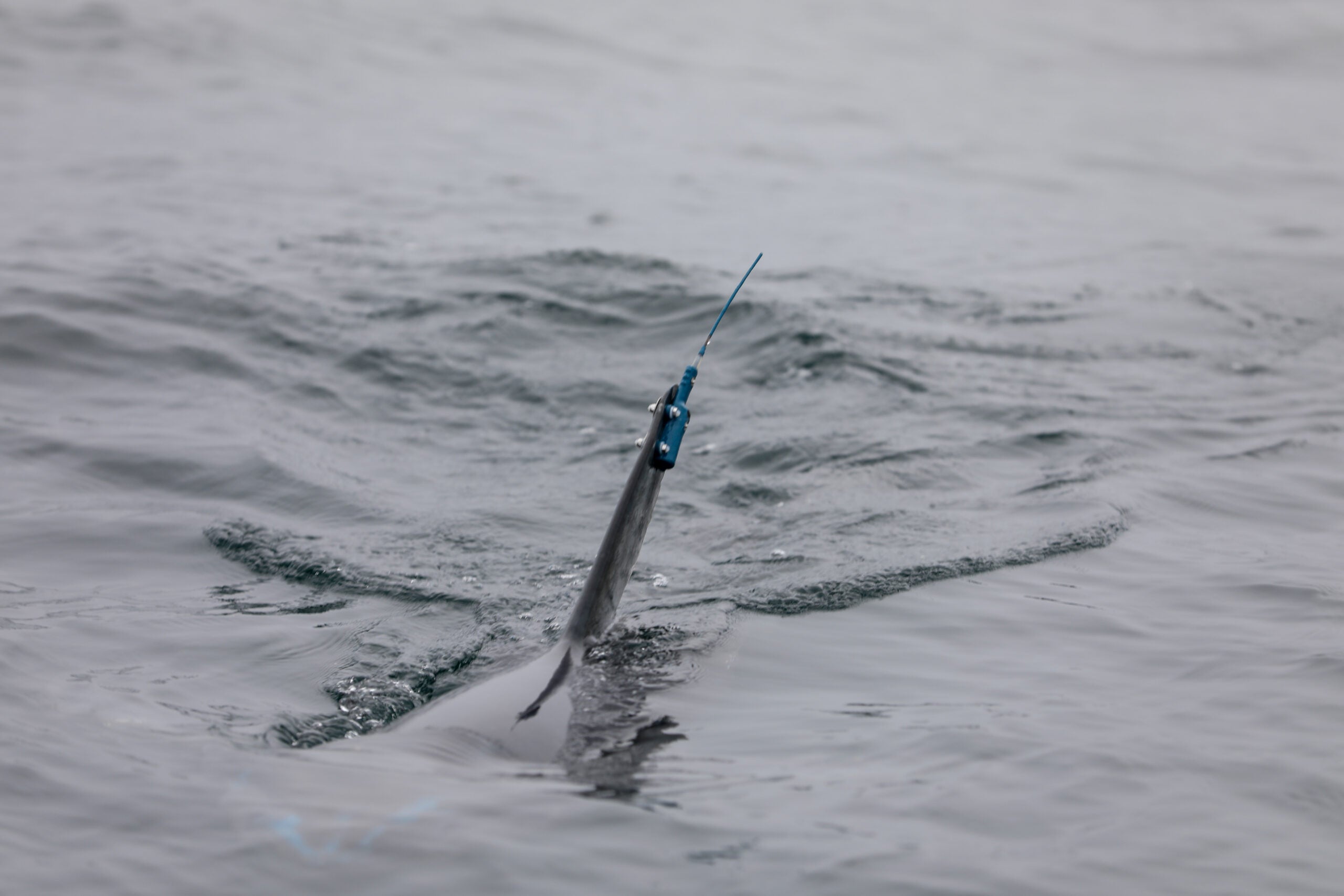
It is that deep
The very first dataset that Thorrold’s team got from a pop-up satellite tag around 2011 was from a collaborator, Greg Skomal, who put tags on basking sharks off Cape Cod. Basking sharks, the second largest living fish after the whale shark, hang out there in the summer, but then they disappear. “And it’s always been this question of where do they go,” Thorrold says. “People thought they literally sank to the bottom, went to sleep, and came back up in the spring.”
But the tags that they affixed to the sharks popped up seven months later in the Caribbean. At first, when one tag appeared there, they thought it was a fluke. Then about a week later, a second one popped up in the Caribbean. “The interesting thing is that basking sharks have never been reported from the Caribbean ever,” Thorrold says.
When they got the tags back, they could see why. “They’re on the surface here on Cape Cod, but when they leave for the winter, they dive, and they never come to the surface. They’re at 200 to 1,000 meters [the Twilight Zone] for months at a time. And they’re only deep down in the Caribbean. There’s no way of knowing that they were there, but they were absolutely there.”
Previously, one way to get more information was through double-tagging, or putting both the pop-up tag and the SPOT tag on the same animal. Around 2012, Thorrold and his colleagues started doing just that: putting both tag types on sharks, big rays, and whale sharks. “The one behavior we found really quickly was that everything we tagged went deeper than we thought,” he says. This includes whale sharks, who have hidden their nurseries from plain sight.
Over the next few years, more studies came out suggesting that there is a rich, and relatively unknown ecosystem filled with big fish and other organisms, residing in the Twilight Zone.
“What was interesting was that our tagging data was showing that the sharks know it’s there, and the rays. So when they’re in the open oceans, especially in these open ocean gyres where there’s not a lot going on on the surface, they’re all diving deep,” Thorrold says. “There’s a biological question of how dependent these predators are on this deep water biomass—we’re still interested in that question.”
They did this with a tropical deep water shark, the blue shark, and were able to used the bolstered data to show to how these sharks were using the ocean weather, in particular, warm core eddies—warm spiraling masses of water—-to get down into the deep ocean (presumably to feed) in ways they couldn’t do if the eddies weren’t there. “It just showed us this interaction between ocean currents, particularly these smaller-scale, little storms in the ocean, and the fitting ecology of these large predators,” Thorrold says.
A new tag
Currently, the team is testing out a new type of tag, called ROAM. It’s significantly smaller than the SPOT and pop-up tags. The heart of it spans only a few inches, and it could allow researchers to locate animals in low light, even if they don’t come to the surface. “It’s a full ocean depth tag that allows [us to do] tracking over large areas of the ocean, but with sufficient accuracy to allow us to do these types of analysis that we do when we can get GPS-type location data out of the SPOT tag,” Thorrold says. In essence, it takes the data researchers get from both the SPOT and pop-up tag and combines it into a single device that’s smaller, so can be put on more types of fish, like tuna or swordfish.
“That was our scientific motivation for the ROAM tags, the idea that [whether] these different types of fishes are using the same kind of features that the sharks are using,” says Thorrold.
The ROAM tag isn’t an entirely new technology. It’s a miniaturized version of a RAFOS float, a 6-feet-long glass cylinder which can measure temperature, salinity, and pressure. Both the tag and the float also contain a hydrophone and a clock.
The tags, like the floats, listen for sounds produced by an array of fixed beacons that researchers have set out in the ocean. These beacons, or sound sources, are large tubes attached to oceanographic moorings that produce a sweep of sound signals from 261 to 263 Hertz at about half a mile down because that’s where the deep sound channel is in the ocean. “It’s a frequency that certainly some animals will be able to hear, but not loud enough to form a shockwave,” Thorrold explains. In this channel, sound can travel for hundreds of miles. Because it spans long distances, there doesn’t need to be that many sound sources to cover pretty large swaths of ocean. It’s mostly programmed to beam out a signal for about 35 seconds twice a day.
When the tag detects a signal from the sound source, it records and puts a time stamp on it. With a few assumptions, about the speed of sound through the water mass, researchers can estimate a distance between the tag and the sound source. If the tag can pick up signals from two sound sources, that narrows it down to two places where it could be. And if it can pick up three sound sources, that triangulates its location. Data from the ROAM tags are transmitted back via satellite when it pops up at the end of its journey.
“It becomes feasible to think about deploying sound sources and then deploying tags and tracking these fish throughout the water column over large areas of the ocean with great accuracy,” Thorrold says. “You put that all together and you have a pretty transformative technology for determining where animals go in the ocean and what types of features they might be using to do it.”
The usefulness of the ROAM tag is dependent on the coverage of sound sources in the area scientists are working with. That means that researchers have to design their array carefully. This summer, Thorrold and his team will be looking into how far apart they should place these beacons in order to get the most out of them. They have already put out two sound sources into the ocean, and they have plans to put out another two. That, he estimates, should give them “pretty good coverage in an area where the Gulf stream starts to make its way offshore and forms a ton of eddies.”
Using these tags to inquire about that location in particular is a big part of WHOI’s Ocean Twilight Zone project. They’re being deployed alongside other tech like robots and eDNA samplers. Although the team is starting with a couple of sound sources in the northwest Atlantic, there’s a potential to extend this cover to parts of Greenland, the UK, and Europe.
By providing more data on how the ecology of the Twilight Zone works, and how these large predators use it to get around the world, Thorrold hopes that they can inform future efforts on international conservation and dynamic fisheries management—both protecting endangered species like whale sharks from gear entanglement while maintaining food security.
“There are new fisheries management approaches that we want to push, that we want to help implement. And one of them is called dynamic fisheries management, where it understands that the fish are moving,” says Thorrold. “We’ve got all this great tech, we can locate where the fish are, where the fishing boats are, and we can be much smarter about how fishing is done and where it’s done.”