
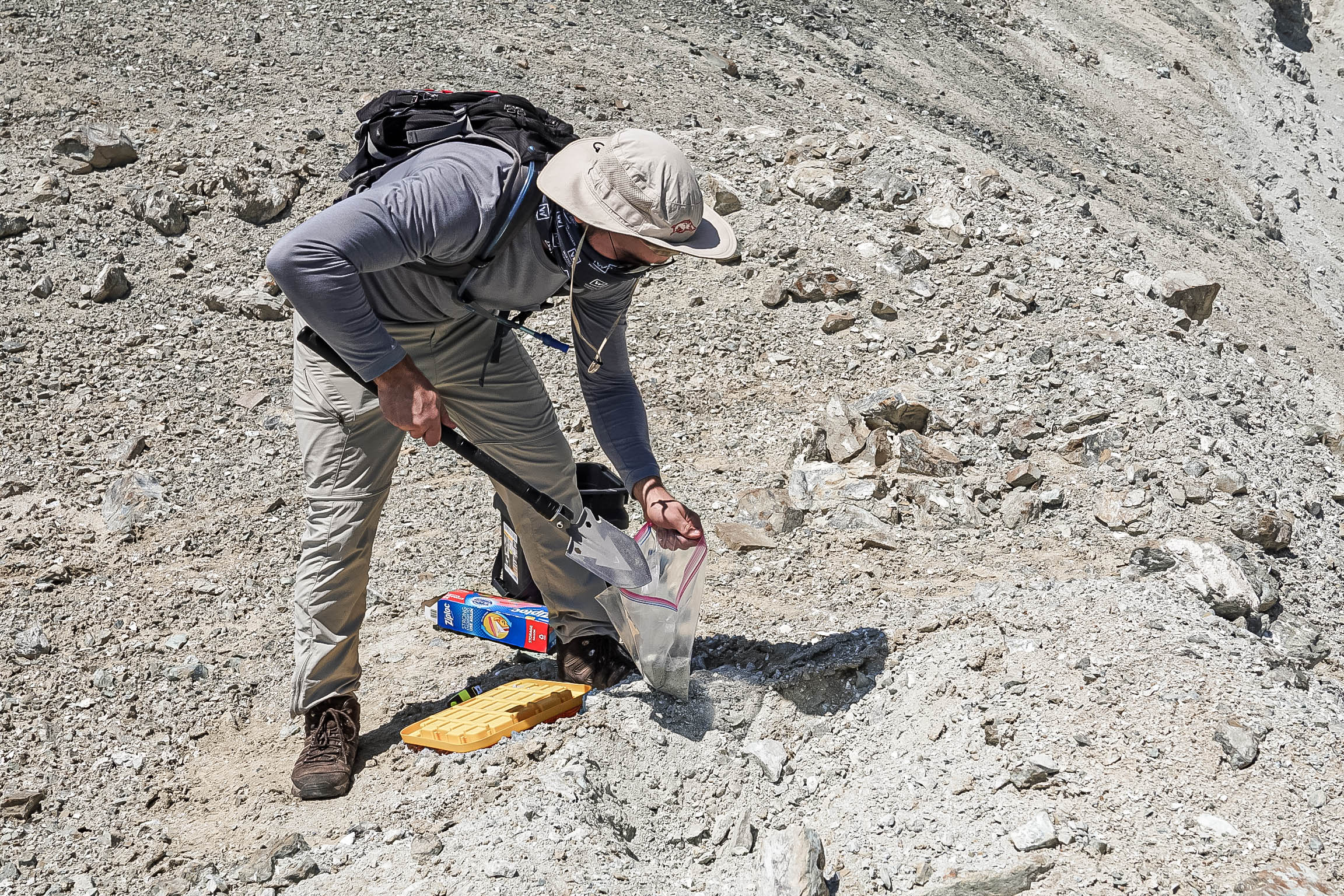
On a scorching day this August, Caleb Woodall wielded his shovel like a spear, stabbing it into the hardened crust of an asbestos-filled pit near Coalinga, California.
Woodall, a graduate student at Worcester Polytechnic Institute in Massachusetts, was digging out samples from an asbestos mine that’s been shuttered since 1980, a Superfund site on the highest peak in the state’s Diablo Range. He extracted pounds of the material from several locations across San Benito Mountain, shoveled them into Ziploc bags, and shipped them to a pair of labs for analysis.
He and his colleagues are trying to determine the makeup and structure of the materials pulled from the pits, and to answer two critical questions: How much carbon dioxide do they contain—and how much more could they store?
The vast surface area of certain types of fibrous asbestos, a class of carcinogenic compounds once heavily used in heat-resistant building materials, makes them particularly good at grabbing hold of the carbon dioxide molecules dissolved in rainwater or floating through the air.
That includes the most common form of asbestos, chrysotile, a serpentine mineral laced throughout the mountain (serpentine is California’s state rock). The reaction with carbon dioxide mainly produces magnesium carbonate minerals like magnesite, a stable material that could lock away the greenhouse gas for millennia.
Woodall and his advisor Jennifer Wilcox, a carbon removal researcher, are among a growing number of scientists exploring ways to accelerate these otherwise slow reactions in hopes of using mining waste to fight climate change. It’s a handy carbon-capturing trick that may also work with the calcium- and magnesium-rich by-products of nickel, copper, diamond, and platinum mining.
The initial hope is to offset the ample carbon emissions from mining itself using these minerals already extracted in the process. But the real hope is that this early work allows them to figure out how to effectively and affordably dig up minerals, potentially including asbestos, specifically for the purpose of drawing down vast amounts of greenhouse gas from the atmosphere.
“Decarbonizing mines in the next decade is just helping us to build confidence and know-how to actually mine for the purpose of negative emissions,” says Gregory Dipple, a professor at the University of British Columbia and one of the leading researchers in this emerging field.
Accelerating a very slow cycle
The UN’s climate panel found that any scenario that doesn’t warm the planet by more than 1.5 ˚C will require nearly eliminating emissions by midcentury, as well as removing 100 billion to 1 trillion metric tons of carbon dioxide from the air this century. Keeping warming below 2˚ C could necessitate sucking out 10 billion tons a year by 2050 and 20 billion annually by 2100, a study by the National Academies found.
That’s such a giant amount that we’ll almost certainly need to use a variety of methods to get anywhere close, including planting trees and increasing carbon uptake in agricultural soils. The particular promise of using minerals to pull down carbon dioxide is that it can be done on a massive scale—and would effectively store it away forever.
Mineralization is already the main mechanism nature uses in the so-called “slow carbon cycle.” The carbon dioxide in rainwater dissolves basic rocks, producing magnesium, calcium, and other compounds that make their way into the oceans. There, marine life converts the materials into shells and skeletons that eventually turn into limestone and other rock types.
There are more than enough minerals to tie up all the carbon dioxide we’ve ever emitted and more. The problem is that the vast majority are locked away in solid rock that doesn’t come into contact with the greenhouse gas. Even when they’re exposed in rock outcroppings, it takes a long time for these reactions to occur.
But a variety of interventions can transform the natural slow carbon cycle into a faster one. Those include physical processes like simply digging up the materials, grinding them down into finer particles, and spreading them in thin layers, all of which increases the reactive surface area exposed to carbon dioxide. There are also ways to speed up the chemical reactions by adding heat or compounds like acids.
“This is the giant, untapped opportunity that could remove enormous amounts of CO2,” says Roger Aines, head of the Carbon Initiative at Lawrence Livermore National Lab, who accompanied Woodall on the California field trip.
The right recipe
Dipple is exploring a variety of ways to do this.
In a pilot project last year, funded by the diamond company De Beers and Natural Resources Canada, he and colleagues used tailings from a mine in Canada’s Northwest Territories to ensnare carbon dioxide released from a tank. The point was to evaluate the possibility of using minerals to capture and store the gas from the flue stream of a power plant.
The team is now conducting a field trial for a proposed nickel plant in British Columbia. They’ve placed tailings from exploratory drilling into assorted containers, and are measuring the reaction rates that result from using different chemical additives and processes under different weather conditions. But they expect that simply adding water and effectively tilling the materials will rapidly remove carbon dioxide from the air, forming a solid block that can be buried.
Because the proposed operation would run primarily on hydroelectric power, they estimate that putting to use just 30% of the most reactive tailings from the mines would make the operation carbon neutral. Using about 50% would make it carbon negative.
But not all mine tailings are created equal. In a separate project, Wilcox and Woodall are conducting fieldwork at a platinum, palladium, and nickel mine in Montana, in hopes of developing ways to accelerate carbon-capturing reactions with less-than-ideal by-products. The main minerals in the tailings there are plagioclase feldspars, which hold magnesium and calcium in a tight chemical structure, making them less reactive than other types of mine waste.
Back in the lab, they’re testing whether applying heat and adding ammonium salts and certain weak acids can break down the bonds, freeing up more calcium and magnesium to grab hold of carbon dioxide.
“If we can come up with a recipe on all these different tailings, the opportunities could explode,” Wilcox says.
Next steps
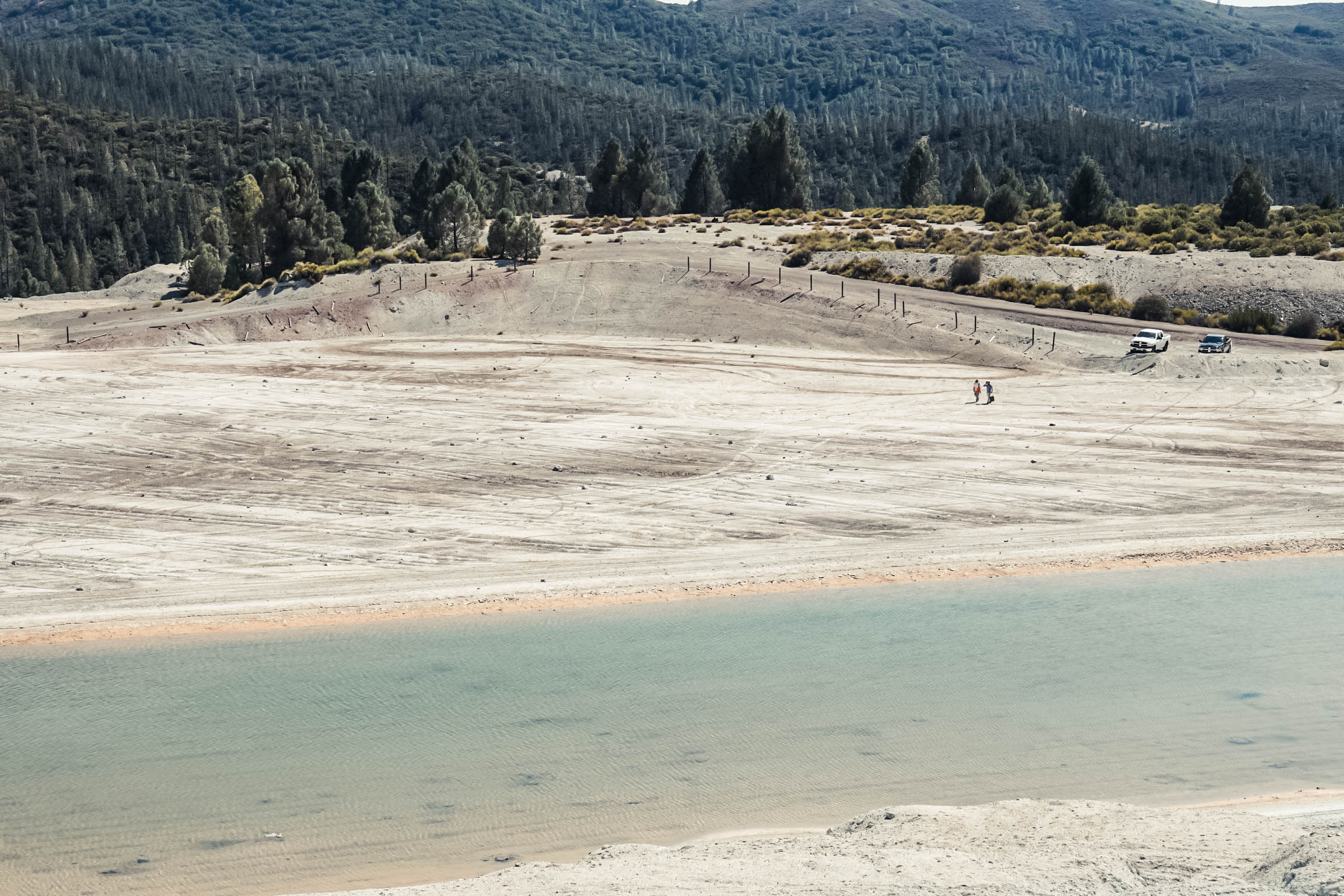
Woodall is exploring asbestos sites because he hopes to find one that might work well for a subsequent field trial to evaluate ways of accelerating carbon uptake.
The approaches could include spreading the material out to increase the reactive surface area, running fans that increase the amount of air flowing over the asbestos, or directly injecting concentrated carbon dioxide into the mineral pits.
Over time, these processes should form a mix of loosely bound rock and dirt, mainly composed of magnesium carbonates, bicarbonate, and calcium carbonate, that could simply be left in place, Aines says. Converting the asbestos would help to clean up these areas as well.
But is it safe to blow air around asbestos? And would such efforts fully remediate these toxic sites?
ROGER AINES, LAWRENCE LIVERMORE NATIONAL LAB
Given the health risks of asbestos, where—or even whether—any subsequent work takes place will depend on the determinations of scientific oversight boards and regulatory officials.
It’s possible that some amount of asbestos would remain or could be dispersed in the course of doing the work, Aines says. Those are among the key questions that would need to be tested, he adds.
It’s also why it’s important to do such work at a restricted site, and why any research or subsequent full-scale efforts would need to follow the clear rules and processes for working with these materials. Woodall stresses they would take all the necessary precautions, including spraying down the materials with water to prevent asbestos from floating around, as well as using sensors to monitor exposure levels.
Coming challenges
Ultimately, mine tailings on their own won’t get us very far.
Woodall estimates that one asbestos site in Vermont, with about 30 million tons of waste, could capture as much as 12 million tons of carbon dioxide. Mines globally produce enough mineral by-products to capture nearly 40 million tons of carbon dioxide per year, according to the National Academies study.
But all that is just a tiny fraction of the billions of tons of carbon dioxide that must be captured to meaningfully address climate change. So getting anywhere near the necessary scale will requiring digging up more of the minerals.
Woodall and Aines both say that could include asbestos, given how reactive it is, if field trials show the process is effective and safe.
But that idea is sure to raise serious concerns given the health risks posed by asbestos. And there are lots of other mineral options, even if they’re not quite as ideal.
Other research groups and nonprofits are already looking at ways to put additional minerals to work once they’re extracted, including: spreading ground-down olivine along beaches or sprinkling basalt dust onto farmland to absorb carbon dioxide and help fertilize crops.
Mining for any materials on a far larger scale, however, will face a number of challenges. Mining itself is environmentally destructive. All the energy required to extract, grind, distribute, and process the minerals will eat into any emissions reductions. And there could be serious limits on the available land, particularly since it can take years for most of the minerals to react with carbon dioxide.
For example, removing 2.5 billion tons of CO2 per year using magnesium oxide would require a 10-centimeter-thick (nearly 4 inches) layer covering about 15,000 square kilometers (almost 5,800 square miles), according to a Nature Communications paper in July. That’s equivalent to a little more than 5% of Nevada.
But the major stumbling block is the cost. Wilcox says it can run more than $200 per ton all-in, which is far more expensive than planting trees.
It’s possible that some of the materials could go into commercial products, like the aggregates in concrete, to defray the costs. Some level of voluntary carbon offsets, where people or corporations pay to balance out their own emissions, could help as well. But getting to the scale of billions of tons, most observers believe, will take aggressive public policies that put high prices on carbon pollution or create generous incentives for removing it.